
Fields Inside Long County Property Tax Records
A Long County property tax record works best when you read it as several linked records. It is not one number. The Board of Tax Assessors decides taxability, fair market value, and assessed value. It also handles equalization and exemption status. Billing is a separate job. The Tax Commissioner handles the bill itself, collection, payment status, tax executions, and tax-sale administration. Compare both sources for the same parcel and tax year before drawing any conclusion.
| Record field | Meaning in Long County | Official source |
|---|---|---|
| Fair market value | The assessor's estimate under Georgia valuation rules | Board of Tax Assessors qPublic |
| Assessed value | Generally 40 percent of fair market value before exemptions | Board of Tax Assessors qPublic |
| Exemption and taxable value | Relief applied before the tax calculation | Board of Tax Assessors |
| Bill and payment status | Tax due and the portal's status for a selected year | Tax Commissioner AssuranceWeb |
| Millage | Rate applied to taxable value by the relevant authorities | Official millage notice and bill |
A deed amount or a listing price answers a different question. Neither is a substitute for fair market value, assessed value, taxable value, or the amount due in county property tax records. Use each figure for its own purpose.
Why Long County Uses Two Property Tax Offices
The office split resolves a common point of confusion. Questions about value, classification, field visits, exemptions, or an assessment notice belong with the Long County Board of Tax Assessors. Bill and payment questions belong with the Tax Commissioner. qPublic states this division plainly. Following it keeps a billing question away from the valuation staff.
The assessor sits at 285 S McDonald Street in Ludowici and lists 912-545-9111. Posted office hours run Monday through Friday, 8 a.m. to 5 p.m. Countywide notices can differ from an office page. Confirm current hours before an in-person visit.
Frame any call or letter around the office's actual role. Give the assessor the parcel number, assessment year, notice date, and the field you believe is wrong. Give the Tax Commissioner the parcel or bill number, tax year, payment date, and the status shown online. A recorded tax execution or tax-sale deed may be the target. In that case, take the same identifiers to the Clerk of Superior Court. That routing step keeps three records from being treated as one file.
Search Long County Property Tax Records by the Right Key
The Long County AssuranceWeb tax search offers several controls, so start with the strongest identifier you have. A parcel number is usually safer than a name. An address helps when the number is unknown. Select the intended year and status before reading any result.
| Search control | Use | Reading caution |
|---|---|---|
| Tax year | Choose 2015 through 2025 or All Years in the inspected response | Earlier coverage was not verified |
| Payment status | Limit results by the portal's listed status | Status is tied to the displayed bill and date |
| Type | Narrow the kind of tax account | Keep the result tied to the property parcel |
| Search by | Use parcel, bill number, address, or name | Names and street forms can vary |
| Results and print | Review or preserve the returned bill details | A printout is not title proof |
The official tax portal appears at the start of that search. Open the live Long County tax search before relying on the controls or available years.
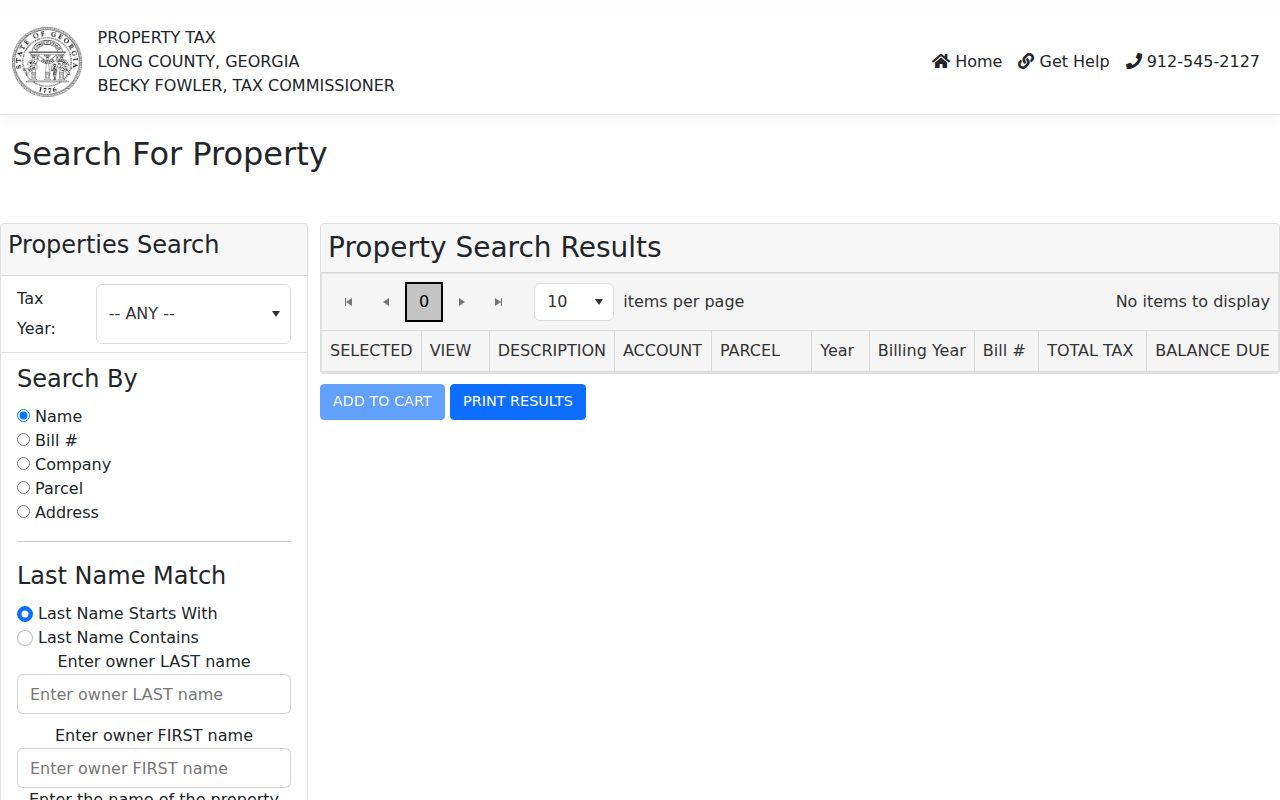
Use the image to spot the right county tool. The live result supplies the bill year and current status that matter for the parcel.
Follow a Long County Tax Bill From Parcel to Status
A reliable lookup moves from identification to interpretation. Follow that order every time. Save the source date too. qPublic and AssuranceWeb may refresh on different schedules, so a date saved now tells you which system is current. If the address search fails, pull the displayed and normalized parcel keys from GIS. Then retry the tax portal with those. Never guess how groups or spaces should be handled.
- Choose the tax year and search the Tax Commissioner portal by parcel, bill number, address, or owner name.
- Open the matching result and confirm parcel and situs details before reading the amount.
- Check the qPublic assessment record for fair market value, assessed value, exemptions, and taxable value.
- Preserve the year and payment-status date; ask the Tax Commissioner about an unclear or older bill.
- Search clerk records separately if a lien, tax execution, or tax-sale deed is the real question.
- Assessed value
- The value generally set at 40 percent of fair market value under Georgia law.
- Millage
- The rate applied to taxable value by the authorities that set the levy.
- Homestead exemption
- Property-tax relief for a qualifying owner-occupied home after approval.
- Tax lien
- A claim tied to unpaid tax; payment status alone does not explain every title issue.
Long County Property Tax and the 40-Percent Rule
Georgia Department of Revenue guidance sets most property at 40 percent of fair market value for assessment, a standard found in O.C.G.A. §48-5-7. Fair market value carries its own statutory meaning under O.C.G.A. §48-5-2: what a knowledgeable buyer would pay a willing seller in a bona fide arm's-length sale. So the assessed figure connects to market value but is not the same thing.
The math runs in a straight line. Fair market value gets multiplied by 40 percent, then reduced by any exemptions that apply, and the result is taxable value. Millage is applied after that step. Preferential programs play by different rules, so the parcel's classification and approved exemptions control the outcome. To dig into how that number is built, see the Long County property value guide.
Long County Homestead and Current-Use Forms
The Long County exemption page lays out homestead eligibility. It also covers the local options the county offers. April 1 is the regular filing point for the current year. Age-based details sit on the official page. After a homestead exemption is granted, it usually renews on its own. The renewal stops only when the owner's circumstances change.
The qPublic forms page also carries the PT-283A current-use agricultural assessment application. Other state forms appear there too. A form itself proves nothing. Filing it does not mean approval. Submit the form to the assessor. Include the requested support. Confirm the exemption lands in the right year's Long County property tax records.
Buying a home or handling an estate changes the math. Compare the exemption the prior owner held with what should follow the transfer. Homestead relief depends on qualifying ownership and residence. Current-use agricultural treatment runs on its own application and covenant rules. Never carry an old taxable value forward as a forecast. Ask the assessor which application, supporting facts, and filing date fit the new owner. Keep the office response with the annual record.
Appraisal staff may visit a property for an appeal, return, addition, new construction, or parcel review. The qPublic home page notes this. A visit can explain later record changes. It does not mean the public card and the tax bill update together. Match the inspection or notice date to the digest year first.
Contest a Long County Property Tax Assessment in Writing
An assessment appeal in Long County can stand on three grounds. These are value, taxability, or uniformity compared with similar property. The size of the tax bill is not one of them. Evidence worth filing includes the notice and photos. It can also include a survey or plat where it matters, plus sale information and genuinely comparable parcels. A taxpayer can go through the Board of Equalization. Another path the official appeal guidance describes is also open. Put the argument in writing and let the documents carry it.
Use the current notice. In the inspected 2026 cycle, notices were mailed June 23 and appeals were due August 7 by mail or in person; email and fax were not accepted.
The Long County appeals page sets the filing window at 45 days from the notice. That clock governs whatever notice an owner actually receives. Reading the current notice is the only safe way to file on time with the proper written form.
Compare Long County Tax Digests Without Mixing Years
The assessor page links archived tax digests for 2016 through 2025. Those years make it possible to compare annual roll data across a decade. An archive is still an archive. It cannot promise that every current parcel-card field or later correction is inside it. Record the digest year. Record the search date. Record the parcel number and the exact value being compared.
This is also why qPublic, the bill portal, and a recorded deed can disagree for a stretch. Each system does a different job on its own schedule. A recent deed may arrive before an assessor update. A notice and appeal phase can run ahead of the later bill. Treat every date as one piece of evidence. Do not force the records into a single false snapshot.
For a year-over-year comparison, give fair market value its own column. Do the same for assessed value, exemptions, taxable value, millage, amount billed, and status. Label each source and year. A shifted exemption or rate is easy to mistake for a changed market estimate otherwise.
Request Long County Property Tax Records That Are Not Online
A historic bill, parcel-card copy, underlying notice, or payment history sometimes never reaches the web. Contact the office that holds it. Give the parcel number, situs address, requested years, and desired format. State whether an ordinary or certified copy is needed. One more route exists. The Georgia Open Records Act, O.C.G.A. §§50-18-70 et seq., opens a path to nonposted county records.
State guidance works from a three-business-day response framework when a record cannot be produced at once. It also allows reasonable production charges. Those include $0.10 per page for standard copies under the Governor's guidance. Ask for electronic delivery and a written estimate where practical. Long County's exact copy cost is not published, so request the figure before committing.
For delinquency, a tax execution, or a claimed sale, ask for the precise status and date. Do not trust an old notice. A paid bill does not settle every issue. It does not prove every deed, security interest, lien, or release affecting title has been resolved.