
Long County Deed Types on Record
A deed records a claimed transfer of a real-property interest. The type matters. Different instruments carry different promises, so the label alone tells you little. Long County deed records sit beside security deeds, liens, easements, releases, plats, and tax-sale instruments. Court-linked filings join them inside the clerk's real-estate systems. To read one properly, look past the short index entry. Study the parties, the recording date, the legal description, and the execution language.
| Deed Type | What It Does | Common Use |
|---|---|---|
| Warranty deed | Conveys title with stated warranties | Arm’s-length transfer |
| Quitclaim deed | Conveys whatever interest the grantor has | Interest cleanup or family transfer |
| Security deed | Secures a debt against land | Loan and release trail |
| Executor or administrator deed | Conveys through estate authority | Probate-related transfer |
| Tax or sheriff’s deed | Records a statutory sale instrument | Distressed-property trail |
A security deed or lien is an encumbrance, not the same act as an ownership deed. A release can clear a recorded claim. Estate and tax-sale instruments need extra context from probate, tax, or court files. And keep one caution in mind. Even a recorded deed does not by itself resolve every unrecorded interest or defect.
Long County Clerk and GSCCCA
Sherry McFann Long is the Clerk of Superior Court. She is the local custodian for Long County deeds and related filings. The office sits at 458 So. McDonald Street, P.O. Box 458, Ludowici, GA 31316, and the listed phone is 912-545-2123. The official GSCCCA clerk page identifies the office and its court roles.
For online access, the interface is the GSCCCA Real Estate Index. Its public forms expose party, instrument, county, date, book and page, and some property-search routes. One caution applies. A test result redirected to login. So public form access should not be confused with guaranteed free image access. When a result supplies only a reference, use the clerk's counter, phone, or mail channel. Ask about the underlying record and a plain or certified copy.
The GSCCCA entry screen shows the statewide system that hosts Long County deed records.
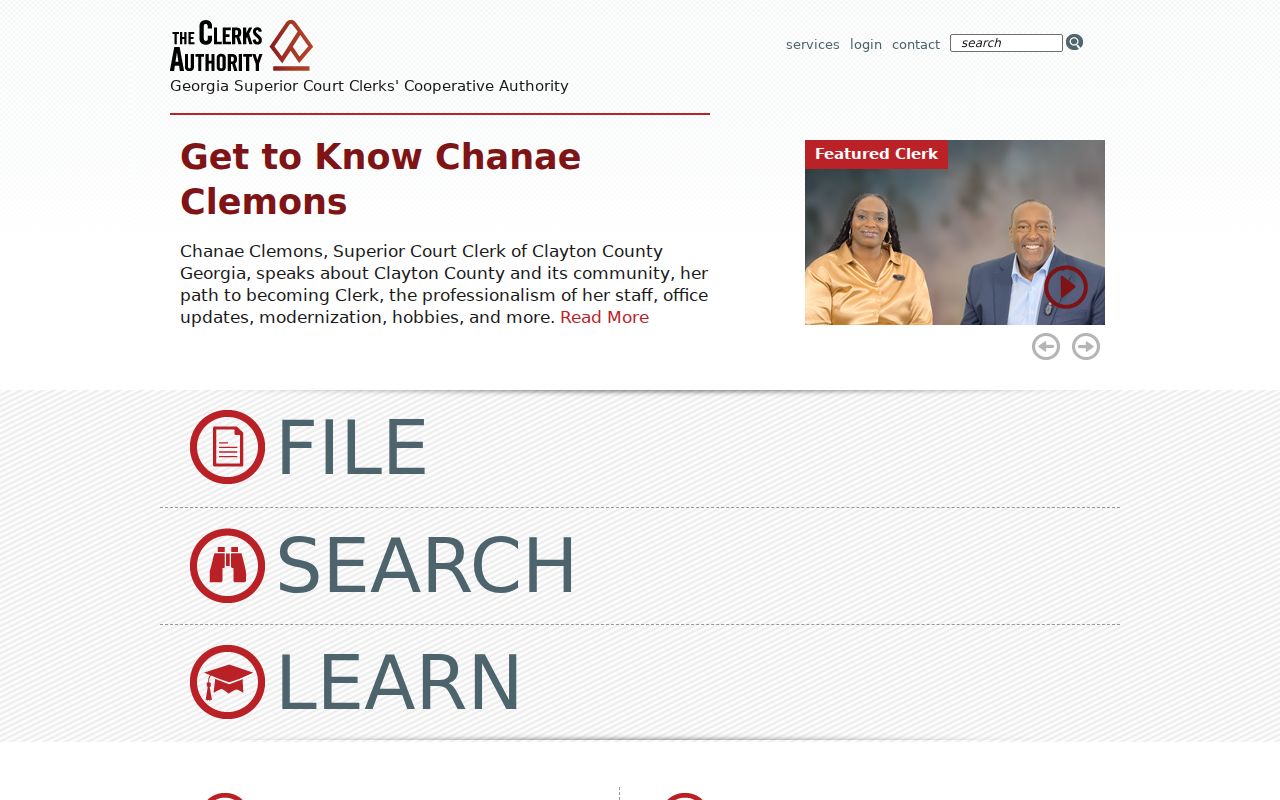
The statewide gateway hosted by the GSCCCA is the front door to Long County deed records. To run a local property search, a visitor first selects County 91 and the correct record system, since results stay tied to that choice.
Long County Deed Index Fields
The name search has enough controls to cut down false matches. Select Grantor for a party who conveyed an interest and Grantee for a party who received one. County value 91 limits the search to Long County. Instrument Type then separates deeds from security, lien, easement, release, foreclosure, tax-sale, estate, and court-linked categories.
| Search field | Choice or format | Purpose |
|---|---|---|
| Party Type | All, Grantor, Grantee | Choose the party’s role |
| Instrument Type | All or a named filing class | Separate transfer from encumbrance |
| County | Long County, value 91 | Exclude unrelated counties |
| Search Name | Last, first for people; exact entity style | Match the recorded party |
| Date range | Month/day/year; year at least 1850 | Reduce common-name noise |
| Display | 5 to 100 rows; three table layouts | Control review and capture |
The neighboring-county checkbox can help with a boundary clue. It can also pull in unrelated land. Keep it off until the Long-only result has been tested, and record the exact search name and filters with each index hit.
Long County Index Starts in 1921
The GSCCCA good-from page for Long County lists January 1, 1921 as its starting date. That is the earliest coverage shown online for the county's deed index. It is not a promise, though. Some images stay closed. Some documents carry indexing errors. Interests recorded before 1921 may simply fall outside the index. Long County itself was formed in 1920 from Liberty County. A title trail that reaches back before the local index may therefore call for Liberty County deed records, older record books, archive assistance, or a direct inquiry to the clerk. Statewide lien and plat systems generally reach back to at least January 1, 2004. Anything older in Long County may need that same offline route. The county coverage screen publishes the January 1921 date. Anyone who wants to confirm it can check there.
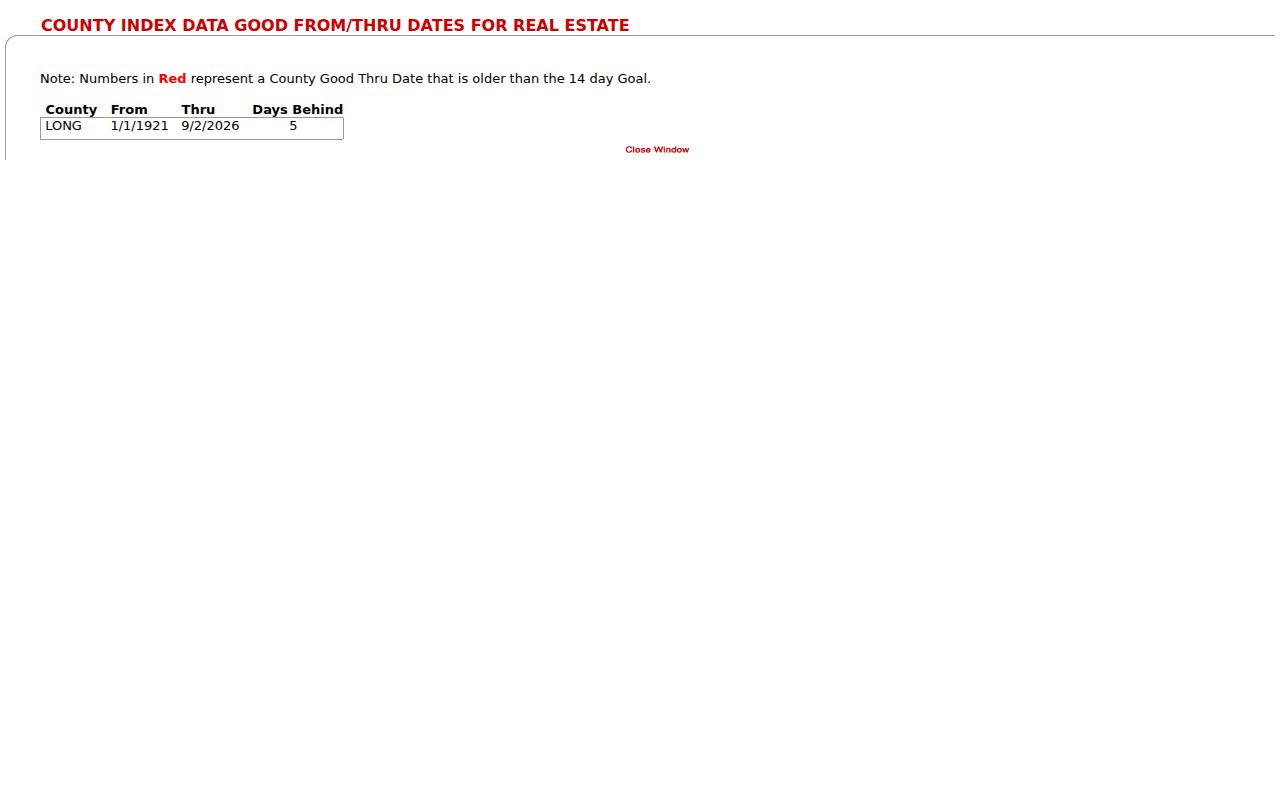
This date guides the search boundary; it documents no fire, loss event, or complete digitization history.
Coverage line. For a pre-1921 chain, ask about older deed books and search the predecessor jurisdiction instead of treating a blank online result as no deed.
Walk a Long County Deed Chain
A grantor-grantee index is arranged around parties, not modern street addresses. Start from a current assessor name only as a clue. Find that party as grantee. Inspect the acquisition instrument. Confirm its legal description or parcel link. The named grantor then becomes your next search term. The goal is to move backward.
- Find the likely current party as grantee and open the acquisition reference.
- Match the land through its legal description, plat, land lot, district, or parcel clue.
- Record the grantor exactly, including initials, entity suffixes, trustee, or estate wording.
- Search that grantor as an earlier grantee and repeat the land match.
- Stop at the 1921 online boundary and shift to the clerk, old books, Liberty County, or archives as needed.
- Grantor
- The party who conveys the stated interest.
- Grantee
- The party who receives the stated interest.
- Chain of title
- The linked sequence of transfers affecting the same land.
- Book and page
- A recorded location used to retrieve a known instrument.
Long County Book and Page Lookup
Another source supplies the book and page first. Then switch from a name search to the GSCCCA Book Page Search. Its visible controls are County, Book, Page, Search, and Clear Form. The system notes that entries are reformatted to accepted standards. Copy the source reference exactly before the form normalizes it. The form itself shows the narrow retrieval route.
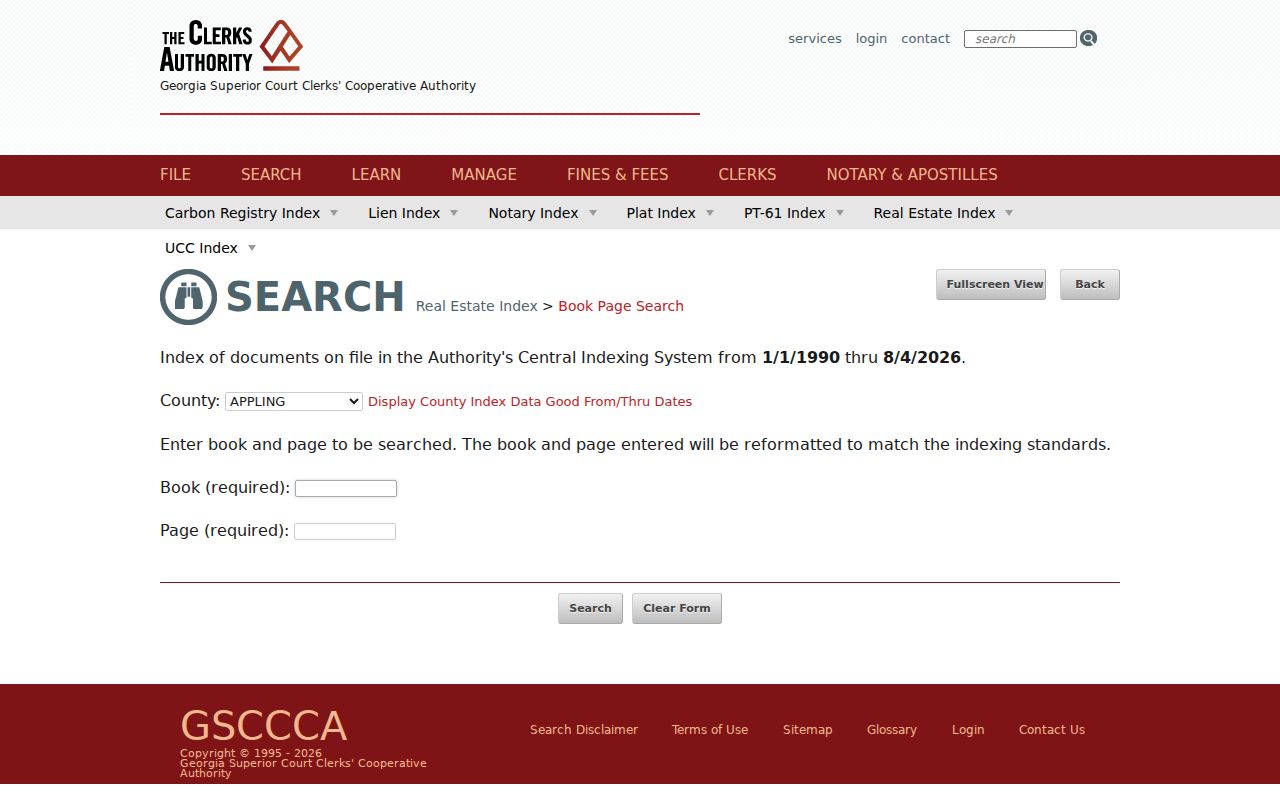
A successful lookup remains an index reference until the image is opened or the clerk supplies the document. Read every relevant page. Check each exhibit, legal description, and signature block tied to the land question.
Plats and Easements in Long County
Deeds in Long County often point to something beyond the parties and the land itself. A single instrument may cite a plat, an easement, a restrictive covenant, a road right of way, a land lot, a district, or an earlier book and page. Follow those references. Do not paraphrase them away, because the recorded wording is what governs. The GSCCCA Plat Name Search supports lookups by instrument type, county, name, Sec/GMD, district, land lot, and date. Display controls help with narrowing results. The GSCCCA property-search form also includes a subdivision field. Long County records may not surface through that route, though.
The county's official GIS subdivision layer names nine recorded plats: Morgan Place, Summer Oaks, Belfair, Burnt Pines, Lee Place, Horse Creek, Davenport Ridge, Way Station Way, and Timberlands. Any of these names makes a useful lead. Trace it back to the recorded reference through GSCCCA or the clerk's office. Keep perspective, though. A GIS polygon is not a legal lot boundary and proves no covenant.
For boundary questions, pair the recorded plat and deed with a current survey by a Georgia-licensed surveyor. The map can point you toward a source. It cannot replace that source.
Long County’s Older Place Names
Ludowici began as Johnston Station and was incorporated in 1905, before Long County existed. Expect both names in early maps, newspapers, and land searches. The county courthouse went up in 1926 and still serves today. The 1907 Ludowici Well Pavilion gives researchers another stable place-name anchor for historic work.
Older legal descriptions lean on roads, creeks, farms, timber, or nearby landmarks. A street address rarely anchors them. Long County's pine lands, farming past, and Altamaha River trade supply useful keyword context for a property search. Local color alone is not parcel proof. Pair each name with parties, dates, land lots, districts, or a recorded deed reference.
The Digital Library of Georgia, Georgia Historic Newspapers, the Georgia Archives, and the Long County Public Library are good starting points. Turn to them when a historical name needs context. Holdings vary. So ask the staff what deed books or directories sit on the shelf before counting on any particular collection.
Request a Long County Deed Copy
Start with the index. Write down the county, the party names, the instrument type, the recording date, and the book/page or instrument number before you do anything else. Images appear at some access levels, so check there first. A login may block the image. None may be exposed. Either way, the Superior Court clerk can pull it by phone, by mail, or at the counter if you give the exact reference. The clerk sets the certified-copy charge, so ask for the current amount and the accepted request method rather than guessing.
Know which copy you need. A plain image supports research, while a certified copy carries the clerk's certification for uses that require it. Neither one is a title opinion. Some deeds sit beside other files. A deed tied to an estate, foreclosure, tax sale, quiet-title case, or court order should be read alongside the related probate, court, or tax file. The deed alone will not tell the whole story.
Keep a simple retrieval log. Record the query, the county, the party role, the instrument filter, the date range, the result reference, and the request date. The office may quote a fee. It may say an older volume sits only at the counter. Save that response with your copy. Long County publishes no official copy-fee schedule online, and fees from another Georgia county should never be assumed to apply here.
Frame the request plainly. Name the instrument and give the reference; do not ask staff to interpret what the deed means. Request the existing page or certified record, not a new chain-of-title report. Only part of a file may be public. In that case, ask for the nonexempt portion. Keep the custodian's written response with your records.
Recorded, not guaranteed. Long County deed records show filed instruments. They do not guarantee clear title, settle boundaries, or reveal every unrecorded claim.