
Reconstruct Long County's Former-Owner Timeline
Build the timeline from the newest transfer, the one naming the current owner of record. A name match alone proves nothing; every link in the chain must carry the same parcel number or legal description.
| Transfer date | Grantor to grantee | Instrument | Record reference |
|---|---|---|---|
| Newest matching date | Prior owner to current grantee | Warranty, quitclaim, estate, or other deed | Instrument number or book/page |
| Earlier acquisition | Earlier grantor to that prior owner | Search every relevant deed type | Book/page reopened in GSCCCA |
| Earlier matched link | Predecessor to predecessor | Confirm the same described land | Index plus deed image |
| Before online coverage | Names found in older county volumes | Deed book, plat, probate, or court record | Clerk, archives, or predecessor county |
One index covers the online era. Use the GSCCCA Real Estate Index for recent deed records, and ask the Clerk of Superior Court for volumes or images the portal does not show.
Cross Long County's 1921 Online Threshold
The Long County good-from page names January 1, 1921 as the real-estate index start. That date is an online boundary only. It does not mean earlier land history is missing. Long County itself was created in 1920 from Liberty County territory, so a pre-1921 deed chain may live in Liberty County records, older deed volumes, or the Georgia Archives. Ask the Long County clerk about pre-1921 material. Clerk staff can also pull unscanned books and help convert an old book and page citation into something usable. Charges and book coverage are not published online. The Georgia Archives, its Virtual Vault, and the Digital Library of Georgia open more finding paths. None of them replaces the recorded deed itself.
Coverage boundary. GSCCCA reports Long County's online real-estate index from January 1, 1921. Earlier owners may require clerk-held deed books and predecessor-jurisdiction research.
Use County 91 and Party Roles to Go Back
GSCCCA lists Long County under code 91. Its name search splits Party Type from Instrument Type, a distinction that matters when rebuilding ownership. Pull the current grantee's deed first. Take the grantor's exact recorded name from it. Then search that name as grantee. The earlier acquisition may sit outside your first guess, so widen the date range when the year is unknown. Controls include last name, first name, party type, county, instrument type, and dates; same-name results get separated by book and page, parcel clues, spouse or entity styling, and the deed's full legal description.
See the Long County Index Before Opening the Deed
The GSCCCA name-search screen offers role and date controls.
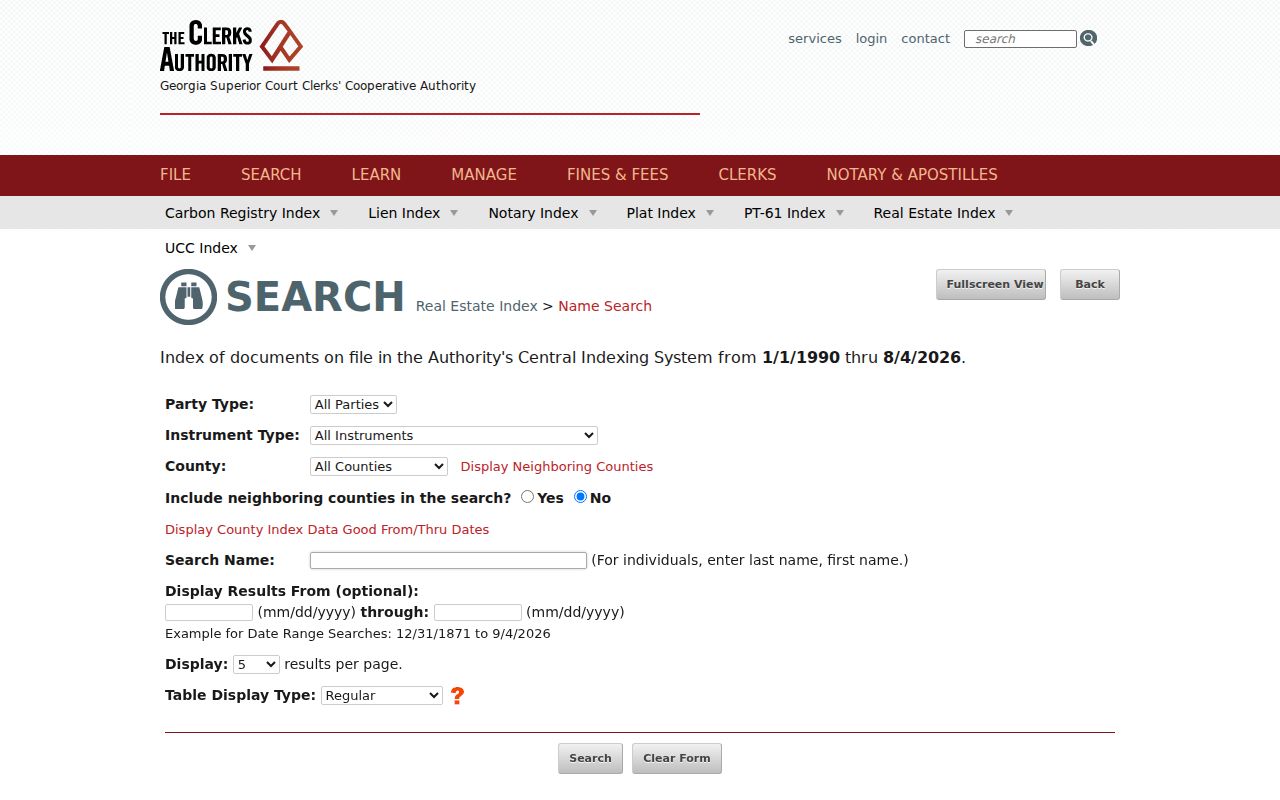
The search screen is only the doorway. Some result details or deed images require an account, so save every book and page reference and ask the clerk for instruments you cannot open.
Walk Long County's Deed Chain in Reverse
A backward deed chain in Long County repeats one controlled move. Each step verifies that the land, not just the owner of record, remains constant through every deed.
- Find the present owner's acquisition deed with that owner as grantee.
- Read the grantor, legal description, deed type, date, and prior references from the instrument.
- Search that grantor as grantee to locate the earlier acquisition.
- Repeat until the 1921 index boundary, then continue through deed books or predecessor records.
- Grantor
- The party conveying the recorded interest.
- Grantee
- The party receiving that interest.
- Chain of title
- The ordered sequence of conveyances affecting the same land.
- Reverse index
- The grantor-oriented path used to find transfers out.
- Quitclaim and warranty deeds
- Different instrument forms that still require examination of their actual terms.
Match Every Long County Link by Land Description
Street addresses are not anchors. They change, disappear, or describe only the house rather than the land. An older Long County deed may name a subdivision, lot and block, district and land lot, metes and bounds, adjoining owners, or acreage. It may also cite a referenced plat. Match those elements before accepting any former owner. The GSCCCA book/page search reopens any citation. For subdivision history, the plat index searches by county, instrument, land lot or district. It also searches by name and date. GIS maps help with orientation. A modern GIS map cannot prove a historic boundary. Let the plat and deed control. Note: Acreage gaps may come from survey methods, later splits, or combinations rather than a different property.
Recover Former Owners Hidden by Estate Styling
Some breaks are only styling. A deed signed by an executor, administrator, trustee, sheriff, or tax official can make the chain look finished when it is not. Search past warranty deeds. Keep phrases like estate of, trustee, and administrator in your notes. The probate file names the authority and the heirs. The deed from the estate records the conveyance itself. The Long County Probate Court offers no online estate-case search, though contact details, forms, and staff guidance are available and the court cannot give legal advice. Court orders may also surface through Georgia Courts E-Access, with a later deed closing the gap.
Place Past Long County Owners in Historical Context
Dates shape jurisdiction in Long County. The county dates to 1920. Earlier deeds therefore fall under Liberty County. Ludowici was incorporated in 1905 and had earlier been called Johnston Station, names that help in newspaper, map, and archive searches. None of that replaces a legal-description match. The 1926 courthouse remains a useful landmark for record research, though not every historical volume is online or in one building. The Long County Public Library can route researchers toward Three Rivers and statewide history resources, and it publishes no Long-specific deed-book or directory inventory.
Continue the Long County Chain Off the Web
Once the portal runs dry, carry a compact chain worksheet to the Clerk of Superior Court. Load it with every owner spelling you know. Add the rough date, deed type, instrument or book and page reference, and parcel identifier. Include subdivision and lot, land lot or district, acreage, and any adjoining-owner clue. Ask whether the deed book, plat, or image you need can be pulled at the counter. It may instead be handled by written request or found at another repository. The clerk's official page lists 912-545-2123 and the Ludowici office address. Estate gaps call for a different stop. Contact Long County Probate Court with the decedent or estate name and a likely date. Staff there can walk you through the process and the available forms. They cannot decide title, though. Court-ordered transfers, quiet-title matters, boundary disputes, tax-sale challenges, and foreclosure documents all live elsewhere. Start with Georgia Courts E-Access. Then look for the later recorded instrument that carried the result into the land record.
The Long County Public Library and statewide historical collections round out the search. Old newspaper names, outdated geographic terms, maps, and local context can sharpen what you bring to the clerk or an archive. Treat them as supporting evidence, never as deed substitutes. Log failed searches as carefully as successful ones. Note the portal, role, spelling, date span, and filter used. You will not repeat the same dead end.
Know Where Long County's Former-Owner Trail Ends
The documented online trail in Long County begins in 1921. Go back further and the work shifts to surviving deed books, predecessor-county records, plats, estate papers, court orders, and archive finding aids. A missing online hit is an access gap. It is not proof that a transfer never happened. Keep a research log of each spelling, role, date range, book and page, description, and office contacted. The chain has to be auditable later.
A chain can also stop at a deed that conveyed only part of a tract. It might instead have reserved an interest. Read the instrument itself. Never assume every grantor walked away from the property entirely. Easements, security deeds, liens, releases, and plats can all shape the history. They can do so without ever naming a new fee owner. When the ownership conclusion matters to a transaction or a dispute, treat the reconstructed timeline as research for a qualified title professional. It is not a substitute for a full examination.
Use the history responsibly. Former-owner research supports house history, estate work, and purchase diligence. Never use current contact clues found along the way to track, stalk, or harass a living person.